
David Sheean
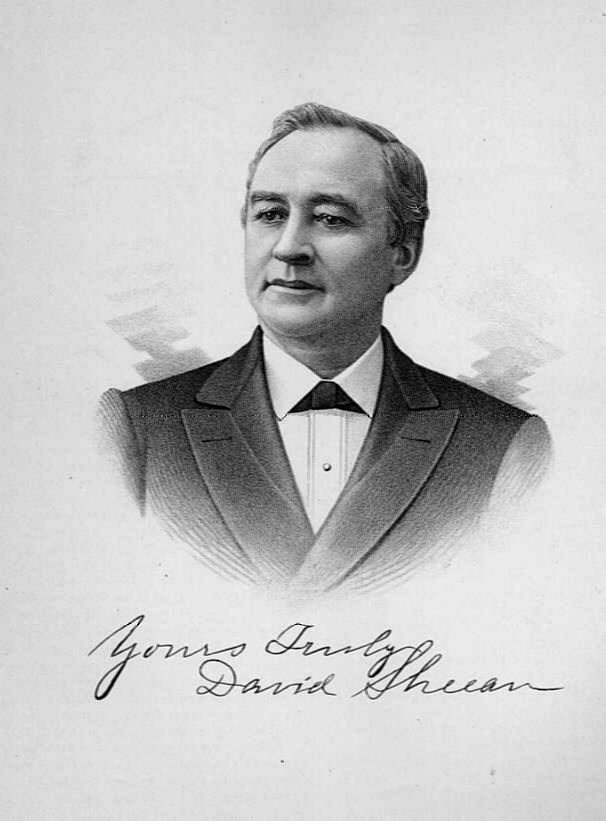
This image of David Sheean appears in the Portrait and Biographical Album of Jo Daviess County, Illinois 1889, which can be checked out from the Galena Public Library.
From the Farm to California to the Bar
He was born on July 3, 1833 in Boston, Massachusetts to James and Mary (Lorden) who had immigrated from County Cork, Ireland. In 1837 the family traveled up the Ohio River to the Mississippi by steamboat toward Galena. They filed a “squatters claim” in Guilford until the land came up for sale.
Growing up on the farm with his four brothers, Sheean attended “common” school then studied for two years at the Galena Academy, a private school on Hill Street. After graduating he taught at both schools before he succumbed to gold fever and made for California in the fall of 1851 at eighteen years old.
After traveling via wagon, train, ocean steamer, mule, river boat, ocean steamer again, then river boat again, he arrived in Sonora in Tuolumne County. He made a claim with Jared Rawlins (brother to John), then returned home to Galena in 1856.
He planned to return to California, but was convinced by his brothers to become a student of law under their boyhood friend John A. Rawlins instead. In January 1858 he was admitted into the State Bar of Illinois and in the same month the firm became Rawlins & Sheean
“Disloyal Practices”
One afternoon while in his office on the corner of Main and Hill Streets, a messenger arrived with an urgent request for representation. An Irishman, Bernard Donnelly, had been assaulted outside of the Enlistment Office then arrested without formal charge. Sheean inquired more once he reached the county jail and learned that the man, while supposedly intoxicated, declared he would not enlist unless the county bounty would be paid ahead of time as he was acquainted with men who had enlisted and were yet to receive the bounty. For this he was beaten by Daniel and Robert Harris until senseless, then dragged off with a howling mob at their backs.
Sheean tried many means to procure release. Since the writ of habeas corpus was often suspended in cases of disloyalty, he filed suit for damages. An impending trial brought the Harrises’ continued vigilante-esque form of perceived justice to an abrupt halt. They sought the advice of a fellow Republican, Congressman E.B. Washburne, who had been toeing the line of bipartisanship for years. Washburne, after having just returned to Galena from an eight month stay in Washington, left for the nation’s capital forthwith. Shortly thereafter, Secretary of War, Edward M. Stanton, sent the following telegram:
Washington, August 27, 1862.
To: J.R. Jones, United States Marshal, Chicago, Illinois.
You will arrest David Sheean, lawyer, at Galena for disloyal practices, and convey him to Fort Lafayette until further ordered.
By order of the Secretary of War.
Jones didn’t waste any time. On August 28, 1862, Sheean was taken from his office into the back alley and put on a train bound for the imposing penal fortress in New York Harbor – Fort Lafayette. Another prominent member of the Democratic Party, lawyer M.Y. Johnson, was led out of Galena the next day.
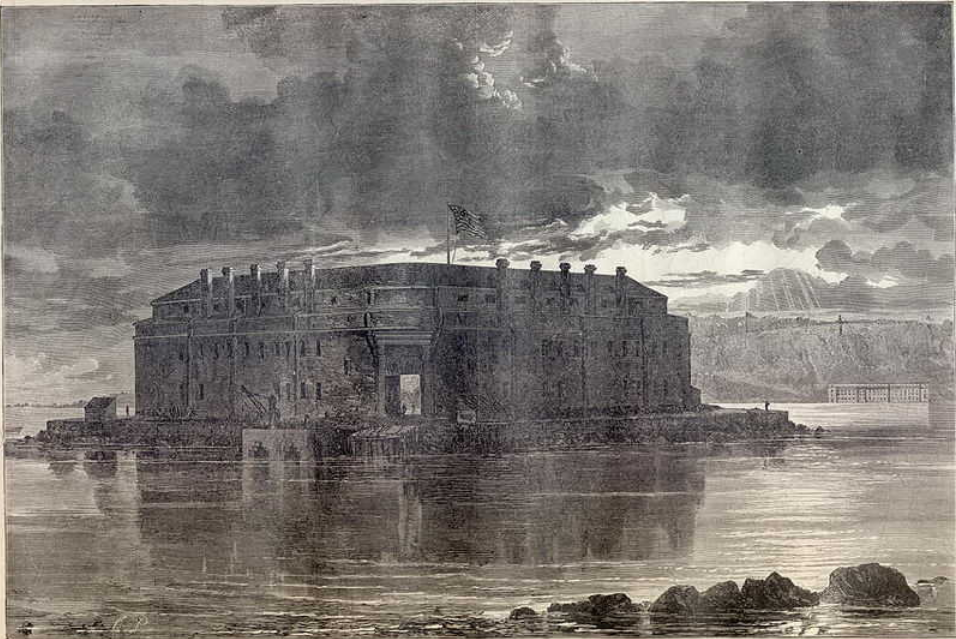
Thrown into the poor living conditions of the “inner sanctum,” they were questioned by Judge Advocate L.C. Turner on September 9. When Sheean was asked if he knew of the reason for his arrest, he responded, “I haven’t the remotest idea, sir. I supposed when a man was arrested he would be informed of the cause and at whose instance; not be required to guess.”
Hearing of his friend’s arrest, his law partner (now General Rawlins) took leave from the war, made his way to Washington, and began an investigation of his own. Upon his return to the army, he drew up papers in Sheean’s defense including a letter from General Grant.
The City Council of Galena unanimously passed resolutions condemning the act of the arrests and sent a request to Washington for a speedy examination of their cases. One thousand citizens of Galena, including a volunteer company, signed a petition with the same request, but all to no avail.
Not to be discouraged, a letter from Sheean to his brother managed to escape in the pocket of a released prisoner in November.
“Let come what will – even eternal imprisonment – no man shall have it to say that I voluntarily disgraced myself or my friends to purchase my liberty. My rights are all I ask, and knowing what they are, I will never yield them. . . . I have heretofore lived true to the best interests of the Union and Constitution, and expect to die as I have lived.”
L.C. Turner returned to the Fort on December 13, 1862 with an order from the Secretary of War for release with parole. Sheean, however, would not have it. “Telegraph,” he responded, “that I will accept no conditions if I stay here a lifetime.”
On the following day, Sheean was unconditionally discharged, taken across New York Harbor, and left to find his way home with M.Y. Johnson who had also been freed. No formal charge had ever been made against either of them.
Returning Home
Sentiments in Chicago were perhaps not what they expected. According to the Chicago Tribune (a Republican newspaper), a marching band played the “Star Spangled Banner" upon their arrival at the Sherman House. The crowd began as icy then quickly progressed into boos, hisses, and shouts of “Traitors!” Johnson and Sheean spoke to the crowd openly condemning the Lincoln administration for arresting and imprisoning American citizens in violation of Constitutional law. Booed back into the hotel, they later convened at the Invincible Club with their fellow Democrats.
The Galena Gazette (also a Republican newspaper), recalled later that “disloyalty waxed rampant” in Galena on the mid-December night of 1862. “The men who sympathized with the criminals prepared them a splendid ovation upon their arrival. Bonfires were lighted upon our hilltops. Houses and businesses were illuminated, fire works were set off, reception speeches were made, and copperheads and traitors gave way to unseemly rejoicing over the release of men who had been expiating the most infamous of crimes. – The night was made hideous with the howlings of a drunken and infuriated mob of traitors.”
Johnson tended toward large declarations against the war and the administration. He made a point to travel to and speak before Democratic rallies throughout the state to condemn federal despotism and transformed an already Democratic leaning Galena Newspaper, the Courier, into one of the most anti-Lincoln publications in the state.
Sheean on the other hand, slipped into the Democratic city government of Galena as City Attorney. Certain local papers continued to lambast him as a “raging traitor” as well as a member of the Knights of the Golden Circle, a pro-slavery, Democratic secret society. None of this prevented him from being elected Mayor in 1865.
 Legacy
So all that said, was Sheean a traitorous Copperhead, a member of pro-slavery secret societies, or a rebel sympathizer?
Both him and Johnson pursued legal recourse against the perpetrators of their arrest and false imprisonment, J. Russel Jones, Daniel S. Harris, Robert S. Harris, Elihu B. Washburne, and George L. Webb. The court ruled in their favor, declaring that the defendants pay $1,000 to the plaintiff “on the account of said wrongful seizure and imprisonment.” The circuit judge entered a final judgement that Sheean “was never a member of the Knights of the Golden Circle, knew nothing of its activities or its purposes except from common report, and was never engaged in discouraging enlistments unless the suit for false imprisonment should be considered as such discouragement.”
The debate as to whether or not he discouraged enlistments or joined secret societies was revived in the Letter to the Editor section of the Industrial Press when Sheean ran for a Senatorial seat 1880. He did not win.
Eight Sheean men after him would become respected lawyers. In 1892 the City Council appointed him to the newly formed Galena Public Library board of trustees. The following year he was elected its president, an office he held until his death in 1920. He also served as the president of the Jo Daviess County Bar Association and on the boards of the Greenwood Cemetery, the Merchant’s National Bank, the Galena Fishing Club, and the Upper Mississippi River Valley Improvement Organization.
His niece, Bertha Sheean MacCulloch in her Sketch of David Sheean and Partly of the Sheean Family wrote, “To the writer, his relatives, and friends, the significance of being placed and retained in those various positions of trust and responsibility, is the satisfactory proof of the estimate to the public of the loyalty, integrity, and faithfulness during his career.” In 1897 a publication entitled, Illinois of To-Day and Its Progressive Cities, a short biography of him stated “He has never been a member of any secret organizations.”
In the end, he was considered one of the best lawyers in the State of Illinois and the Galena Daily Gazette said he was a “good man, a wise councilor, and a staunch friend.” Or so they wrote after his death on January 27, 1920, fifty-seven years after the Advertiser accused him of evil and treason.
To learn more about David Sheean click here to view archival articles, photos, documents, and more.
Written by Larissa Distler, Adult Services Librarian, Galena Public Library
With Special Thanks to Mike Fertig, Dale Glick, and Steve Repp, Historical Librarians, Galena Public Library
Sources:
Margaret Gardner: In Her Own Words compiled by Marilyn Johnson, Galena’s Old Stockade: Used During the Blackhawk War 1832 compiled by Florence Gratiot Bale, Galena’s Old Stockade: Used as a Refuge for Settlers During the Black Hawk War in 1832 compiled by May Belle Rouse from notes of research done by Margaret Gardner, Galena Daily Advertiser, Galena Daily Gazette, Galena Daily Courier