
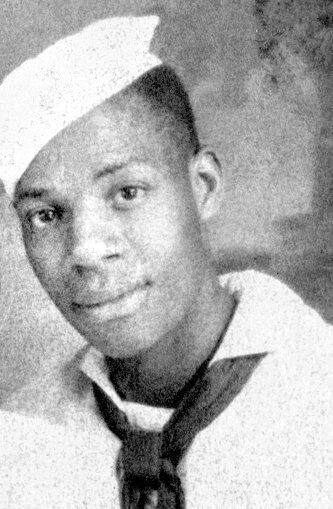
Beaford Clark Johnson in 1943 at 19 years old.
Beauford Clark Johnson
Born in 1922 as a third generation Galenian and grandson of formerly enslaved individuals, Beauford Clark Johnson served in the U.S. Navy for twenty-three years including time in the Pacific during World War II, the Korean War, and the Vietnam War. He experienced the desegregation of the military as well as the passage of the Civil Rights Act.
Due to the efforts of historians such as H. Scott Wolfe, a light has been shone on the Black citizens of Galena’s history, making names such as Barney Norris, Swansey Adams, Moses Lester, Henry Wagoner, and Thomas Johnson familiar to Galenians of today. The descendants of these men and others lived and worked in Galena for decades.
Three Generations of Galenians
The Johnson family legacy in Galena begins with Thomas who moved from Tennessee after his wife Mary Jane’s father Moses Lester accompanied Dr. Edward Kittoe to Galena (a great story for another day).Thomas became a well known figure in town at the turn of the century. He worked as sexton for South Presbyterian Church for many years as well as a boot blacker on Main Street and in the Desoto House Hotel. The Daily Gazette reported on his many ventures, mishaps, and successes over the years including a few fun anecdotes about cooking up coon with all the southern fixings and preserving watermelons for the winter by storing them in crates full of sand. Thomas and Mary Jane had eleven children, four of whom lived to adulthood.
His son Garrett Dey Johnson (who went by Dey) lived and worked in the Galena area for most of his life in various occupations. According to the census records, he was employed as a fireman for the gasplant, a bell hop for the Merchant’s Hotel, and a maintainer for the Savannah Ordinance Depot. When he wasn’t working, Dey was a musician and performer who played mandolin and guitar. He and his wife Mossie had nine children. Those children recalled a good childhood in which they never felt poor, but never felt rich either. They lived by the examples of their parents who taught them to work hard and be more.
Four of their daughters became nurses. One of whom, Meredith, graduated top of her class. Two of their sons became ministers of the AME Church. Their daughter, LaMetta, served as Mayor of Clinton, IA.
A Life of Service
Their son, Beauford, was working at the Savanna Ordnance Depot the day after the attack on Pearl Harbor, December 8, 1941, when the U.S. declared war on Japan and entered World War II. By June of 1942, he registered for the draft. He was nineteen years old when he officially began his naval service in February of 1943.
At this time, the U.S. military was segregated. Many Black soldiers reported mistreatment by white servicemen and officers to the NAACP. Some described horrific treatment and slave-like conditions. As a result, Black newspapers questioned the hypocrisy of fighting and dying for democracy while being treated like second class citizens.
Beauford served as a Commissaryman (Cs2), in other words, a cook. Many politicians strongly campaigned against allowing Black soldiers to serve in combat or even carry weapons, preferring them to be assigned to support positions. Beauford cooked for and served mostly white crews while everyone on board shared the danger of their service equally.
While on leave in May of 1945 after nineteen months, the Galena Gazette celebrated him with a short article entitled, “Colored Galena Sailor Had Thrilling South Pacific War Experiences.”
It describes his P-T boat being rammed by a Japanese “tin can” and cut in half. The unnamed radio operator held steadfast to his post and signaled for help before going to his death in a successful effort to save the crew. In another tale, the Gazette describes an instance in which Beauford was among servicemen who landed on an island they believed to be uninhabited until a “cleverly camouflaged native” was spotted “at a nearby tree ready to send poisonous arrows into the group. The native was disposed of and the island was left to its head-hunting natives.”
When Beauford had come into port in California he ran into another Galenian, George Hartwig, the first he’d seen since his training in the Southwest. George was surely a welcome sight. After visiting his parents in Galena, he traveled to visit his sisters and brothers before reporting to Melville, Rhode Island at the end of the month.
Just a few months later, the war officially ended on September 2, 1945. Beauford continued to serve longer after. Integration didn’t occur until Harry Truman signed Executive Order 9981 in July of 1948. Full integration still did not happen until the Korean War (1950-1953), in which Beauford also served. At forty-one years old in August of 1963, eight years into the Vietnam War, he retired from military service.
The First Civil Rights Case in Dubuque
Months after the Civil Rights Act was passed into law, a tavern owner in Dubuque, Iowa refused to serve Beauford a bottle of beer on November 2, 1964. Newspapers reported the trial that followed to be Dubuque’s first Civil Rights case.
At the time, Beauford was working at a hotel in Clinton, Iowa. After visiting with his parents in Galena, he took a bus to Dubuque and stopped at a tavern owned by Frank Lucas to buy a hamburger to-go, but when he asked for a beer, Lucas would not sell it to him. Beauford walked out and came back with the police. Lucas claimed Beauford never asked for a beer. Beauford’s testimony stated he was told he had already had too much to drink. Witnesses in the bar as well as the police officers involved stated he was not intoxicated.
A Black woman, Inez Sibley, was called by the state to testify as she’d known Lucas for years. She stated that he told her in September when he opened his tavern that she and her friends could order carryout beer, but he wouldn’t “serve colored people because there are just not enough of them to make it worthwhile.”
Lucas’s attorney objected to the admission of this testimony. His objection was sustained until after a recess when the judge allowed Inez’s statement to remain on the record. At the end of three and a half hours of testimony, the judge took the case under advisement and promised a ruling within a week or so.
On December 24, The Belleview News Democrat reported that Frank Lucas had been fined $15 under Iowa’s 1962 Civil Rights Law.
And So, A Life is Lived
Beauford lived out the rest of his life after retiring from naval service in Freeport as a member of many organizations including the Bethel AME Church in Clinton and the Eastern Star Lodge. He served as the Chaplain of the VFW Freeport post and Master Mason at Meridian Lodge 89 also of Freeport.
He passed away on November 26, 1992 at seventy years old. Graveside military rights were conducted by the Moline American Legion at Rock Island National Cemetery on Arsenal Island.
***
To learn more about Beauford Clark Johnson, click here to view a selection of items.
Researched and Written by: Larissa Distler, Adult Services Librarian, Galena Public Library
Special thanks to: Mike Fertig, Historical Collections Librarian, Galena Public Library, Dale Glick, Historical Collections Librarian, Galena Public Library, Kris Chapman, Galena Historical Society