
Barney Norris
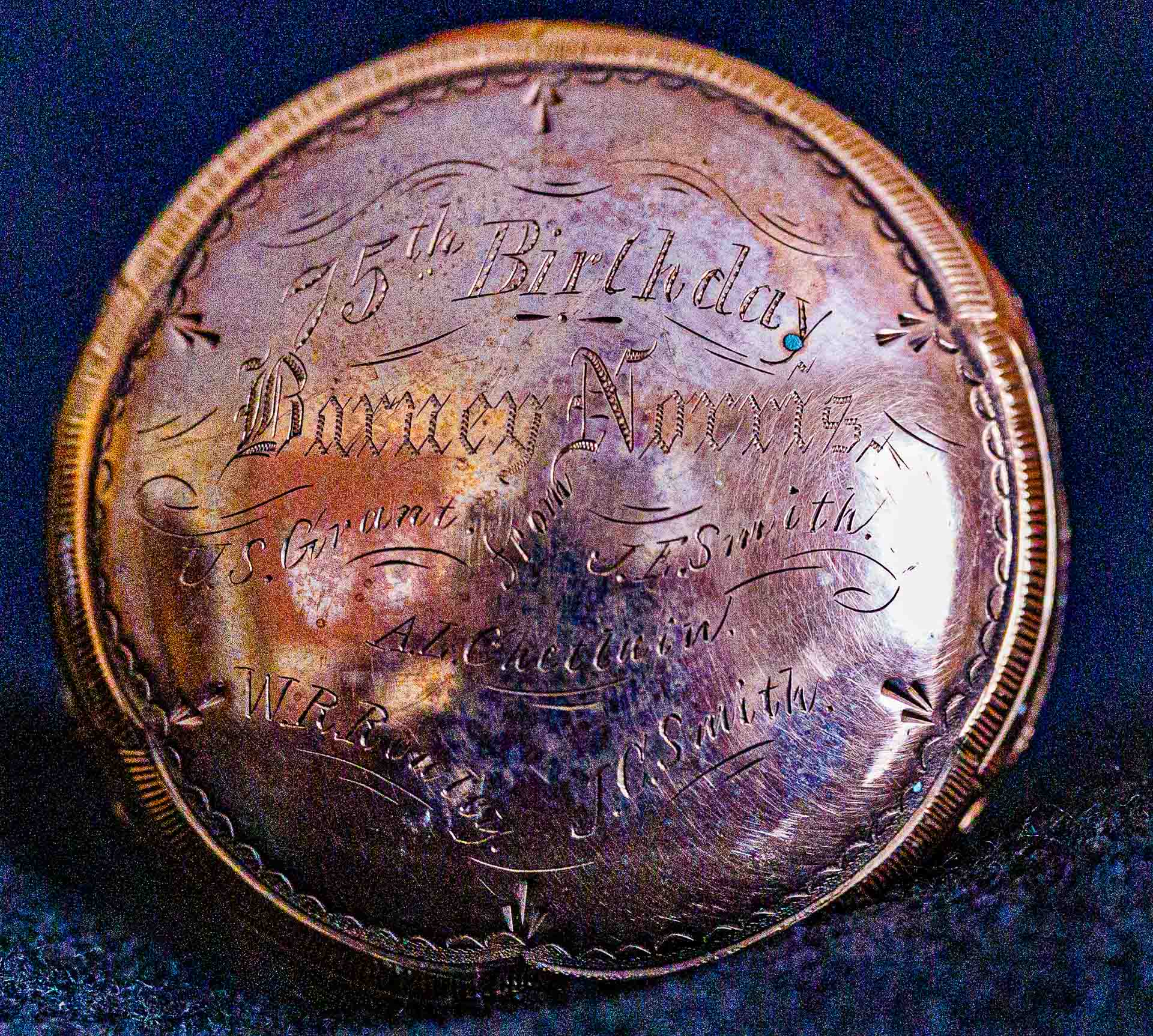
Gold head of the cane gifted to Barney Norris by Galena's Civil War generals. Photo provided by the Galena and U.S. Grant Museum.
There are different accounts in regards to the birth of Galena’s remarkable citizen, Barney Norris. By some he was born free to parents of partly African descent. By others he was born enslaved into the household of naval officer Commodore Stephen Decatur. Both accounts state he was born in Washington City, which had not abolished slavery until April 16, 1862, when Congress passed the District of Columbia Compensated Emancipation Act. This act freed over 3,000 enslaved individuals in the capital.
If he had indeed been born into or worked for the Decatur House, the rest of the story includes an interesting tale in which Barney accompanied Decatur to his infamous duel with disgraced Commodore James Barron on March 22,1820 at which Decatur met his death.
There are also references to him hailing from Alexandria, Virginia where he allegedly was once acquainted with Robert E. Lee. Some told of his great friendships with Jefferson Davis and Fredrick Douglas with little proof. So, dear reader, one must take all this with a grain of salt (or perhaps several).
Whatever his true origins he had little education, but worked in the homes of Washington City’s powerful families and had access to books and print material enough to learn to read and write. From 1826 to 1828 he worked for the family of President John Quincy Adams as a table boy and a body servant in the White House.
He, and all those who knew him, enjoyed his remarkable memory for events and people that served him very well his entire life. It was said that he could recount in their entirety the conversations between the famous men and women he served at the White House and other homes in Washington City. He could recite all the presidents of the United States and the years they’d been elected and retired from the office as well as every defeated presidential candidate.The Gazette lamented that his story would have “furnished material for an interesting article, had we the time to write it.”
He moved on from the capital and came to Galena as the personal servant of Thomas C. Legate, 3rd Artillery of the United States Army. Barney accompanied him through the Black Hawk War in 1832 then to Galena in 1834 when Legate was appointed as the Superintendent of Lead Mines.
Barney made quite a name for himself once he settled into town. He owned a home on West Street and perhaps lived there for a time, but soon bought a parcel of land on auction in 1838 at the corner of Jackson and 3rd Streets on the East Side for $65 on which he built a home. The home stood on the site until 2008 when it had fallen into disrepair and was demolished.
On May 4, 1843 he married sixteen year old Mary Petand De Baratz in St. Michael’s Catholic Church. The two of them enjoyed a long marriage and had seven children.
It’s unclear when Norris left Legate’s service. In 1844 he became the sexton of the 2nd Presbyterian Church, a position he held for over thirty years. Many fondly remembered flocking to the church for service while Barney rang the bells.
In the spring of 1849 he decided to try his luck when he accompanied Colonel William Stephen Hamilton (son of Alexander Hamilton) to California during the gold rush. They traveled on two prairie schooners, likely with other 49ers. On October 9, 1850, Hamilton died in Sacramento City during an outbreak of Cholera. Barney prepared the body for burial and returned home to Galena. Later when it was questioned where Hemilton’s body was laid to rest, Barney returned to California to point out the location.
Reportedly, he had returned home with a small fortune from California, but through several bad investments it did not endure. He returned to his position as sexton, but it was not his only post. Throughout his long life he also worked as a janitor for Seminary Hill School and the Post Office, whitewashed and papered many public and private buildings including the Market House, and had a very lucrative catering business. He appears in the Galena Gazette in conjunction with many, many high profile weddings and events as the Prince of Caterers or the Prince of Cuisine, preparing every kind of food from fancy fare to barbecue. Due to his experience in Washington nearly every fashionable wedding deferred to his expertise on table settings and menu preparation.
Also well known as a fisherman and rower, Barney would take to the Galena River and the Mississippi with his yawl boat, the General Grant. Crowds gathered along the banks of the Galena and over the Green Street bridge to watch rowing matches.The Gazette reported in 1875 that Barney and a Mr. George Ferguson returned from a fishing trip at Rock Slough on the Mississippi and threw a six pound salmon on the floor of the office, reporting that they had caught nearly one hundred more of similar size thus making the two men deserving of going “down into history as the best fisherman in ‘these ‘ere parts.’”
Still enjoying good health, eating heartily, sleeping well, and continuing to work, Barney celebrated his seventy-fifth birthday. The officials at the Post Office and Customs House presented him with a box of Beismann’s best cigars, but the highlight of the day was when he was presented with an engraved, gold headed ebony cane by the five remaining Civil War generals in Galena - U.S. Grant, W. R. Rowley, J.E. Smith, A.L. Chetlain, and J.C. Smith
“What Galenian,” wrote Captain G. W. Girdon in The History of Jo Daviess County (1878), “can ever forget Barney Norris? He still lives among us, hale and hearty, although the frosts of many winters rest upon his faithful head. ‘Faithful to duty’ has been his motto ever, and ever will be, until he tolls that bell no more.” Barney did indeed remain strong and capable well into his old age, maintaining all his many jobs in the homes and halls of Galena.
He was sharp and hearty until the last two or so years of his life. The post master found him unresponsive one day after his duties had begun. Barney was bed ridden for two weeks attended by Dr. Crawford before succumbing to his illness at a little after six o’clock in the evening on April 18, 1888. His death was widely publicized across the country. His wife and six children survived him including a daughter who was married to Mr. Reynolds of Dubuque, a conductor on an Illinois Central sleeping car and his eldest son, William, who resided in Omaha, Nebraska and was in charge of a sleeping car on the Union Pacific Railroad.
And so Galena mourned the loss of an old settler and esteemed citizen who was “liked by all” and “strictly honest and true to every trust that was confided to his keeping.” His wife, Mary, passed away at the age of ninety-one in their home at 300 Jackson Street on December 27, 1915. She had her own reputation as an old settler having moved with her family as a child of six from St. Louis, Missouri to Galena in 1834. At the time of her death she’d been the oldest member of St. Michael’s Catholic Church and a great story teller of Galena’s early days. Both Barney and Mary were laid to rest in St. Michael’s Cemetery.
To Learn more about Barney Norris, check out a selection of items from the Galena and U.S. Grant History Museum and the Galena Public Library archives here.
Written and Researched by: Larissa Distler, Adult Services Librarian, Galena Public Library
Researched by: Mike Fertig, Historical Collections Librarian, Galena Public Library